Nature Microbiology 2025 (Jul); 10 (7): 1630–1647
Fig. 1. Abundant gut bacterial species bioaccumulate and tolerate PFAS over a broad concentration range.
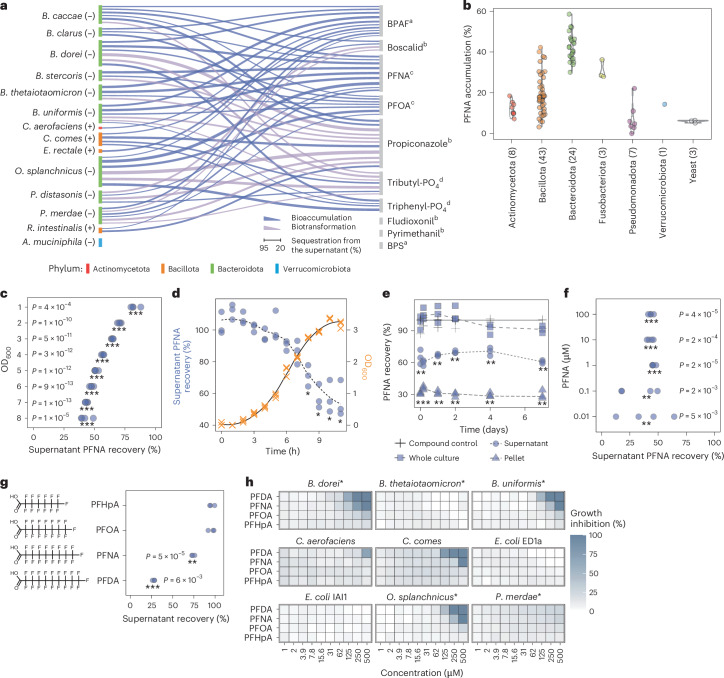
A, Specificity of human gut bacteria to sequester (bioaccumulate and biotransform) chemical pollutants during a 24-h growth period as identified using mass spectrometry. Links between bacterial species and pollutant denote >20% depletion. The link thickness is proportional to the median depletion from 6 replicates (3 biological, 2 technical; initial pollutant concentration = 20 μM) (Supplementary Tables 7 and 8). C. comes, Coprococcus comes; E. rectale, Eubacterium rectale; P. merdae, Parabacteroides merdae; R. intestinalis, Roseburium intestinalis. Compound class: abisphenols, bpesticides, cper- and polyfluorinated alkyl substances, dsolvent and plasticizer.
B, PFNA bioaccumulation in 89 strains spanning major bacterial phyla, and three yeasts. OD600 = 3.75; initial PFNA concentration = 20 μM (9.3 mg l−1); n = 3 technical replicates (Supplementary Tables 3 and 9).
C, PFNA depletion by B. uniformis cultures at different OD600 values in PBS buffer and PFNA exposure concentration of 20 μM. P values are based on two-sided t-test; ***P < 0.001; n = 4 technical replicates (Supplementary Table 10).
D, Kinetics of PFNA depletion during B. uniformis growth starting with low cell density and 20 μM PFNA. *P < 0.05 and >20% PFNA sequestration from the media compared with the compound control. P = 0.015 (8 h), 0.005 (9 h), 0.012 (10 h) and 0.014 (11 h); two-sided t-test; n = 3 biological replicates (Supplementary Tables 11 and 12).
E, Kinetics of PFNA depletion by B. uniformis at high cell density in PBS over 7 days (OD600 = 3.75; initial PFNA concentration = 20 μM). Two-sided t-test; **P value < 0.01; ***P value < 0.001 (supernatant compared with the compound control; pellet compared with 0); n = 3 biological replicates (Supplementary Table 13). Exact P values in Supplementary Table 48.
F, PFNA is significantly bioaccumulated by B. uniformis grown in mGAM at a range of initial concentrations (initial OD600 = 0.05; initial PFNA concentrations = 0.01–100 μM) compared with the compound control. Two-sided t-test; P value FDR corrected for number of concentrations tested; **adjusted (adj.) P value < 0.01; ***adj. P value < 0.001; n = 4 technical replicates (Supplementary Table 14).
G, Bioaccumulation of PFAS compounds with varying chain length by B. uniformis (OD600 = 3.75; initial concentration for all compounds = 20 μM (PFHpA, 7,280 µg l−1; PFOA, 8,280 µg l−1; PFNA, 9,280 µg l−1; PFDA, 10,280 µg l−1)). Two-sided t-test; **P value < 0.01; ***P value < 0.001; n = 3 technical replicates (Supplementary Table 15).
H, Growth sensitivity of gut bacteria to PFAS is independent of bioaccumulation (n = 3 technical replicates). Asterisks denote bioaccumulating bacteria (Supplementary Tables 16 and 17).