

Symptoms Patients Receiving Manual Therapy Experienced
and Perceived as Adverse: A Secondary Analysis of a
Survey of Patients’ Perceptions of What
Constitutes an Adverse ResponseThis section is compiled by Frank M. Painter, D.C.
Send all comments or additions to: Frankp@chiro.org


FROM: J Man Manip Ther 2021 (Feb); 29 (1): 51–58 ~ FULL TEXT
OPEN ACCESS Martha Funabashi • Lisa C Carlesso
Division of Research and Innovation,
Canadian Memorial Chiropractic College,
Toronto, Ontario, Canada.
Background: Previous qualitative studies demonstrated that the process by which patients determined whether a response to manual therapy is adverse is very complex. However, it remains unknown which responses to manual therapy patients perceived as adverse.
Objective: To describe symptoms patients experienced and perceived as adverse following manual therapy and to explore predictors of adverse responses (AR) for the body region with the greatest number of AR. We hypothesized that patients receiving manual therapy for neck conditions would present with more symptoms perceived as AR.
Methods: This was a secondary analysis of a previous cross-sectional survey of 324 patients receiving manual therapy from Canadian physiotherapists. It included questions regarding symptoms patients experienced after a treatment including manual therapy and perceived as adverse. Poisson and negative binomial regression were used to determine factors associated with the number of symptoms that patients experienced and perceived as adverse.
Results: Symptoms that affected patient's functionality were most often perceived as AR. The neck region was the body part with the greatest number of perceived AR (n = 83). Patients with neck pain who agreed that education may change their experience with AR had a lower incidence rate of AR.
Conclusion: Findings indicate that communication regarding post-treatment symptoms between clinicians and patients is important and can potentially influence patients' perception of post-treatment symptoms.
Keywords: Adverse response; manual therapy; patient perception; survey.
From the FULL TEXT Article:
Introduction
Patient safety has been described as one of the leading health-care challenges and has been receiving increased global attention in the past decade. [1] Patient-centered strategies and initiatives aimed at improving patient safety include patient involvement and participation in monitoring not only their health but also their own safety. [2, 3] With increased patient participation in monitoring safety, it is important to understand what patients consider adverse responses to specific interventions so that clinicians are better equipped to communicate to patients, instruct their participation, and promote a safer culture.
Manual therapy is a popular conservative treatment commonly used by chiropractors, physiotherapists, and osteopaths, and includes spinal manipulation and mobilization. Similar to other interventions, adverse responses have been reported following manual therapy. [4] Most reported adverse responses are benign (or mild) and transient in nature, self-resolving within 24–48 hours. Examples of such benign adverse responses include increased soreness, stiffness, and tiredness. [4–7] However, most investigations of adverse responses to date have focused on patients with either low back or neck pain, used investigator or clinician-reported data with limited consideration to whether patients themselves perceive the reported response as adverse. [6, 8–10] Previous qualitative data have demonstrated that the process by which patients determine whether a response to manual therapy is adverse is very complex. [11] Consequently, it remains unknown what adverse responses patients receiving manual therapy for musculoskeletal conditions in other body regions experience and which of these responses patients actually perceive as adverse.
Patients’ perceptions of what constitutes adverse responses specifically related to manual therapy have been previously investigated. [11] This conceptual framework proposed that the process in which patients define adverse responses is multi-factorial including both contextual factors and an interrelationship between the pre- and post-treatment elements. [11] Additionally, a survey identified predictors of the incidence rate of responses that patients would consider as adverse following manual therapy. [12] This survey found that patients with low back conditions identify adverse responses 51% more than patients with extremity conditions and that patients who expect post-treatment soreness identify adverse responses 8.5% less than those who do not expect post-treatment soreness. [12] While these previous investigations provided important findings, they focused on the responses and perceptions of what patients would consider to be adverse. Importantly, no studies have investigated which symptoms patients experienced after receiving manual therapy are considered as adverse.
Therefore, the primary objective of this study was to describe which symptoms were experienced and perceived as adverse responses following manual therapy in physiotherapy patients with varied musculoskeletal conditions. The secondary objective of this study was to explore characteristics and predictors of adverse responses for patients receiving manual therapy to treat the body region from which the greatest number of symptoms that was experienced and perceived as adverse. Based on previous studies [13, 14], we hypothesized that patients receiving manual therapy to the neck would present with more symptoms perceived as adverse responses following manual therapy.
Methods
Design overview
This was a secondary analysis of data collected during a cross-sectional survey of patients receiving outpatient orthopedic manual physiotherapy between September 2010 and January 2011. The detailed description of the survey can be found elsewhere. [15] Briefly, patients who were receiving physiotherapy treatment for any musculoskeletal problem that included manual therapy were invited to respond the survey. The objectives of this survey were to describe patient perspectives regarding identification and occurrence of adverse responses related to manual therapy and to identify predictors of the incidence rates of the symptoms patients identified as adverse responses.
Survey
Prior to completing the survey, patients were provided with the following definition for adverse response: ‘an unintended response to treatment that may or may not be caused by the treatment’ and were instructed to have that definition in mind when completing the survey. The survey consisted of 18 questions and a patient characteristics section. Questions involved factors potentially associated with patient perspectives of experiencing adverse responses: education regarding treatment, trust in practitioner, treatment expectations, familiarity with post-treatment symptoms and benefit versus harm trade-off.
Potential predictors included in the survey and their respective rationale have been previously detailed. [15] Prior to its use, 10 clinical physiotherapists piloted tested the survey for clarity, face validity of content, readability, comprehensiveness, and technical ease of use. The survey was available to be completed online or in a paper version and is provided as Appendix A.
Identification of respondents
As described previously [15], orthopedic manual physiotherapists working in private clinics across Canada were invited electronically via the Canadian Academy of Manipulative Physiotherapy (n = 485) and the Orthopedic Division of the Canadian Physiotherapy Association’s e-mail list (n = 4,336) to recruit eligible patients to complete the survey. Patients were eligible to participate in the study if they were 18 years old or older, attending physiotherapy treatment for any musculoskeletal condition at the time the survey was conducted for which manual therapy was delivered as part of their treatment and had received at least one session of manual therapy to any part of the body.
Practitioners were instructed to only invite patients who received manual therapy (defined to include manipulation and/or mobilization) as part of their treatment. Patients were not required to have experienced an adverse response to participate, as one of the study objectives was to determine what types of symptoms and reactions patients perceived as adverse. Patients were excluded if they were not receiving manual therapy as part of their treatment or if they were not fluent in English language. Patients initially agreed to be contacted by the investigators. They were then provided study details and taken through the consent process prior to being provided a copy of the survey.
Analysis
Questions on the survey included: ‘Please indicate whether you have experienced any of the following symptoms after your hands-on treatment. Mark all that apply’ as well as ‘Assuming one of the following symptoms happened to you after your treatment. Which ones would you consider to be an adverse response? Mark as many as are applicable.’ The same symptoms were listed under both questions and based on the responses for these questions, a new variable was created composed of those symptoms that were marked as experienced after manual therapy and considered as an adverse response (i.e. patient answered ‘yes’ on both questions for any specific symptom).
Descriptive statistics were used to summarize participant characteristics (including body region being treated), as well as symptoms that were marked as experienced after manual therapy and considered as an adverse response. Poisson regression was used to determine factors associated with the number of symptoms that a patient experienced and considered an adverse response for the treated body region that presented the greatest number of adverse responses. An initial Poisson model was performed using all predictors. [15] A second model was performed including only predictors with p < 0.20 from the first model. All variables were entered simultaneously and a sensitivity analysis for overdispersion was conducted using a negative binomial model on the final model. All analyses were conducted using R: a language and environment for statistical computing (R Foundation for Statistical Computing, Vienna, Austria).
Results

Table 1
Table 2
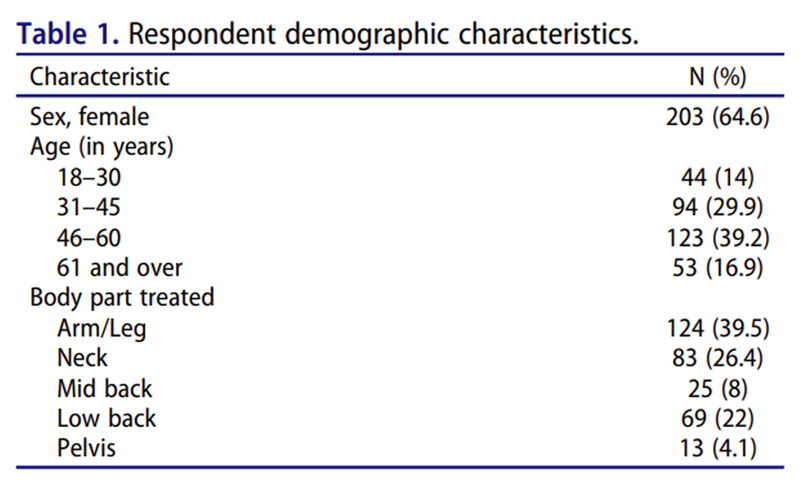
Table 3 From the 425 patients that were invited to participate in the study from 255 Canadian physiotherapy clinics, 324 completed the survey (76.2% response rate). Although a detailed description of patient characteristics has been reported previously [15], for convenience, Table 1 presents the basic demographic characteristics of patients who responded the survey.
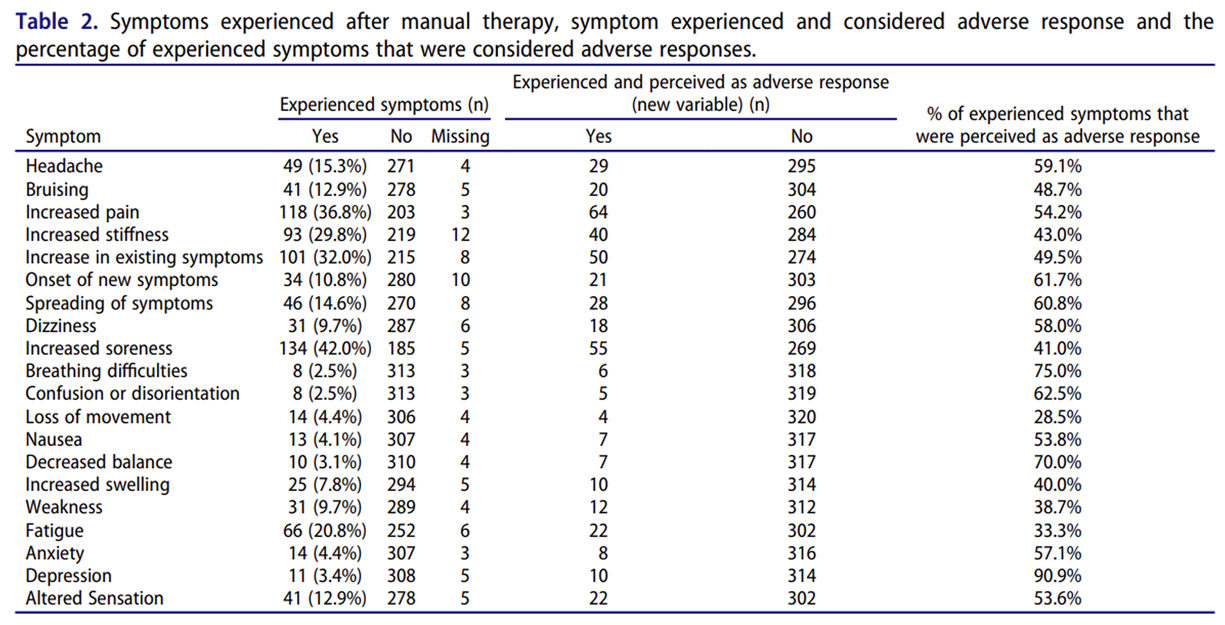
Table 2 presents the list of symptoms patients experienced after manual therapy, the number and percentage of patients who reported experiencing these symptoms, if they considered the symptom an adverse response and the percentage of experienced symptoms that were considered adverse. Although depression, breathing difficulties, and decreased balance were the least experienced (depression 3.4%, breathing difficulties 2.5%, decreased balance 3.1%), patients who experienced these symptoms most often perceived them as adverse: depression 90.9%, breathing difficulties 75%, and decreased balance 70%. On the other end, loss of movement (4.4%), fatigue (20.8%), and weakness (9.7%) were the symptoms that were least often perceived as adverse: loss of movement 28.5%, fatigue 33.3%, and weakness 38.7%.
Table 3 presents the characteristics of patients who experienced symptoms that were considered adverse responses. Patients who experienced symptoms that were considered adverse responses following manual therapy were most often male, aged between 31 and 60 years old, had previous experience with manual therapy, were improving with the treatment provided, and presented with neck pain for >3 months.
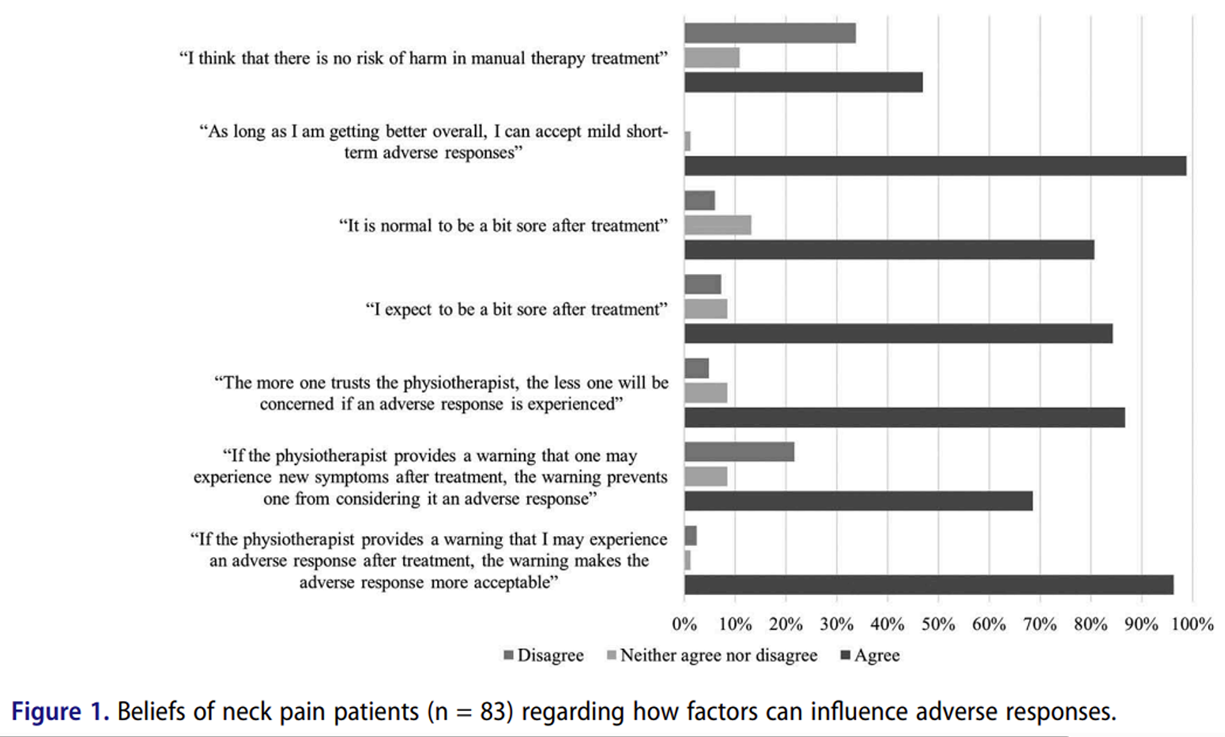
Figure 1 Neck pain represented the body region having the greatest number of symptoms experienced and perceived as adverse responses. Figure 1 presents the agreement of neck pain patients (n = 83) with statements regarding beliefs that may influence how they perceive whether a symptom is adverse. This included how education regarding treatment, trust in physiotherapist, treatment expectations, and perceived risk of manual therapy influence adverse responses. A large majority (>80%) of respondents felt that warning of an adverse response made it more acceptable, trust in the physiotherapist lessens concerns of an adverse response, soreness after treatment is expected and normal, and overall improvement with treatment increases acceptance of short-term mild adverse responses. All patients receiving treatment for neck pain (100%) endorsed the importance of the physiotherapist providing a warning that they may experience an adverse response after treatment.
Given the secondary objective of this study, only patients with neck pain were included in the regression models for the prediction analyses. Variables that were excluded after the first Poisson model (p > 0.2) included: trust in physiotherapist, expectation of soreness, harms versus benefits trade-off and progress in treatment. Although both Poisson and negative binomial regression models were performed, overdispersion was observed in the Poisson model (deviance value/df = 3.152).
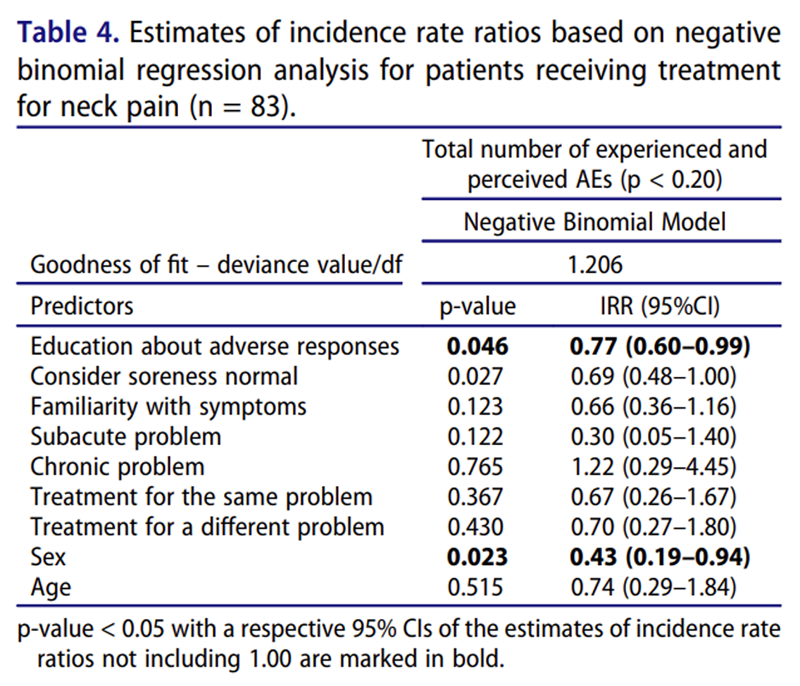
Table 4 Table 4 presents the final model performed with negative binomial regression models as it showed a better fit (deviance value/df = 1.206). Patients receiving treatment for neck conditions who agreed that receiving education about adverse responses may change their experience with adverse responses had a smaller perceived adverse response incidence rate (23%). Male patients with neck pain had a perceived adverse response incidence rate of 57% less than females.
Discussion
This secondary analysis aimed to describe symptoms patients presenting with varied musculoskeletal conditions experienced and perceived as adverse responses following manual therapy, and to explore characteristics and predictors of adverse responses for patients receiving manual therapy to treat neck conditions, which was observed to be the body region from which the greatest number of adverse responses were perceived. The results indicated that although patients receiving treatment for neck pain reported greater rates of responses that are experienced and perceived as adverse, patients receiving treatment for low back and extremity conditions also reported several symptoms that were experienced and perceived as adverse.
Results also indicated that patients with neck pain who agreed that education may change their experience with adverse responses have a lower incidence rate of experiencing adverse responses. Although previous studies have investigated patients’ perceptions related to adverse responses following manual therapy and predictors to what patients would consider adverse responses [11, 15], this is the first study to investigate predictors to responses reported to be experienced following manual therapy and that were perceived as adverse, as well as focused on the musculoskeletal condition that presented with the greatest number of perceived adverse responses. Importantly, results indicated that adverse responses based on patient experience and perception are rare, with each of the identified symptoms occurring in only 2-3% of the total sample.
Symptoms that patients experienced and most often perceived as adverse responses following manual therapy included depression (90.9%), breathing difficulties (75%), and decreased balance (70%). Interestingly, these were not the most frequently reported symptoms patients experienced and, in fact, were among the lowest experienced (depression 3.4%, breathing difficulties 2.5%, decreased balance 3.1%).
Depression is a symptom that was perceived as an adverse response to manual therapy was an interesting finding as we are unaware of any evidence in the literature regarding the association between depression and manual therapy. Eight of the 10 patients who reported experiencing depressive symptoms after treatment and perceived them as adverse were receiving treatment for a chronic condition. It is well described in the literature the association between depression and chronic musculoskeletal conditions. [16–18] Additionally, previous studies have associated depression with higher rates of adverse events in other health-related areas, such as cardiology and nephrology. [19, 20] Therefore, it is possible that similar to other health areas, patients with depressive symptoms may also perceive more symptoms as adverse following manual therapy.
Patients also perceived decreased balance and breathing difficulties as adverse responses following manual therapy. Given that the exact mechanism in which manual therapy affects the body remains unknown and the cross-sectional design of this study, we are unable to ascertain whether these symptoms were caused by manual therapy or were present in participants before treatment. Future studies are needed to further explore patients’ perceptions of these symptoms and their potential association with manual therapy. Nevertheless, these findings indicate that even though some symptoms may not be frequently experienced after manual therapy, when they do occur, they are often perceived as adverse.
Experienced symptoms that were least often perceived as adverse included loss of movement (28.5%), fatigue (33.3%), and weakness (38.7%). Although weakness and fatigue/tiredness are frequently observed following manual therapy and have been reported as common minor adverse responses [5, 8, 21–23], results from this analysis indicated that from a patient perspective, they are not often perceived as adverse. Interestingly, the initial analysis of these data showed that 61% of patients would consider loss of movement as an adverse response to manual therapy. [15] This secondary analysis, however, revealed that among patients who actually experienced loss of movement following manual therapy, only 28.5% considered it as adverse response (Table 2).
Given the patients’ complex multi-factorial process to determine what constitutes an adverse event, it is possible that the loss of movement experienced after manual therapy presented specific characteristics that led patients to not consider it as adverse responses. For example, patients could have been experiencing loss of movement before the treatment, or the loss of movement lasted for few minutes or hours, or was experienced more than 2 days after treatment, or the severity experienced did not have a functional impact. [15] Nevertheless, the exact reason for this discrepancy in perception within manual therapy patients requires further investigation.
Receiving manual therapy specifically for neck conditions was observed to be the body region from which the greatest number of adverse responses was perceived. Neck spinal manipulations and mobilizations are often performed in patients with neck conditions and despite the rarity and lack of causal association of serious adverse events following neck spinal manipulation, such as stroke and vertebral artery dissection, their occurrence frequently receives significant media attention. [24–26 ]
Therefore, it is possible that the media portrayal and focus on serious adverse events following neck manual therapy have influenced patients’ construct of what they perceive as adverse. This could potentially make people with neck conditions more vigilant following manual therapy applied to the neck region and, consequently, more susceptible to perceive post-treatment symptoms as adverse. This is an interesting topic and future studies should be conducted to investigate these findings.
Education about adverse responses and agreeing that warnings about symptoms may change patients’ experience with adverse responses (Figure 1 and Table 4) was found to be protective of experiencing adverse responses after manual therapy. While some have reported that providing a warning may lead to increased adverse response reporting [27], likely by creating a nocebo effect, our findings highlight the importance of communication factors in the occurrence and consequences of adverse responses, previously described by Lang and colleagues (2016). These patients’ driven data suggest that educating patients about possible adverse responses is valued and that an effective provider-patient communication could positively contribute to preventing experienced adverse responses, increasing trust between patient and provider, increasing patient satisfaction, and, consequently, reducing susceptibility to adverse responses. [11, 28] The results observed in the current study highlight the importance of communicating with patients throughout the treatment in a clear and transparent manner using understandable language and disclosing all the risks and benefits related to the planned treatment.
Sex was shown to be a predictor to experiencing adverse responses after manual therapy and male patients with neck pain had a lower adverse response incidence rate than females. This was an interesting finding given that more male patients experienced symptoms that were perceived as adverse than females (Table 3). Nevertheless, this finding is in accordance with previous studies that reported that women are more likely to report adverse responses to spinal manipulation treatment than men. [13, 14]
It remains unknown if these differences are due to specific sex-related physiological phenomenon or women being more willing to report symptoms. [14] Additionally, the types of reported adverse responses after manual therapy have been observed to differ between men and women. [13] Specifically, women report significantly more stiffness, headache, fatigue, and local discomfort [13, 14], suggesting that it is possible that men and women present distinct responses to manual therapy. However, future studies should be conducted to further investigate this topic.
Limitations of these data have been previously detailed and include the survey’s cross-sectional design, its inability to establish any causal association between the reported adverse responses and manual therapy and the inability to describe the experienced and perceived adverse responses beyond what was provided in the survey. [15] This survey defined adverse response as ‘an unintended response to treatment that may or may not be caused by the treatment’, which may not be an universally agreed definition.
While there is no established definition as to what constitutes an adverse response, an interdisciplinary and international study is currently being conducted to reach a consensus on a definition for adverse response following manipulation and/or mobilization, so that future investigations can use a standardized definition and facilitate advancements in this field. Additionally, even though manual therapy was explicitly described to the physiotherapists as including manipulations and/or mobilizations, the description to patients included the term ‘hands-on treatment’, which could include other manual interventions, such as soft tissue therapy, and, therefore, may have been considered when answering questions.
Specific to this secondary analysis, the current study combined patients’ responses of two separate questions (‘Please indicate whether you have experienced any of the following symptom after your hands on treatment’ and ‘Assuming one of the following symptoms happened to you after your treatment. Which ones would you consider to be an adverse response?’). Therefore, patients were not directly asked if the specific symptoms reported to have been experienced were adverse responses. Further investigations with direct questions are needed.
Conclusion
This secondary analysis investigated symptoms that patients experienced after manual therapy and perceived as adverse responses and the predictors to experiencing such symptoms. Our findings suggest that symptoms that affect patient’s mental and physical functioning are most often perceived as adverse responses. People receiving manual therapy treatment for neck conditions are more likely to identify responses as adverse. An effective communication between clinicians and patients regarding post-treatment symptoms is important and can potentially influence patients’ perceptions related to post-treatment symptoms.
Supplementary Material
Biographies
Dr. Martha Funabashi has a physiotherapy background and is currently a clinical research scientist and assistant professor at the Canadian Memorial Chiropractic College in Toronto, Canada. She is also an adjunct professor at the Université du Québec à Trois-Rivières in Trois-Rivières, Canada. Her main areas of research are biomechanics and safety of manual therapies.
Dr. Lisa C. Carlesso is an Assistant Professor in the School of Rehabilitation Science at McMaster University. Her research is broadly focused on understanding pain mechanisms to optimize outcomes for people with chronic musculoskeletal disorders.
Disclosure statement
The authors have no conflict of interest to declare.
References:
Brasaite I, Lecturer RNP, Kaunonen M, et al.
Healthcare professionals ’ knowledge, attitudes and skills regarding patient safety: a systematic literature review.
Scand J Caring Sci. 2015;29(1):30–51.Sahlström M, Partanen P, Rathert C, et al.
Patient participation in patient safety still missing: patient safety experts’ views.
Int J Nurs Pract. 2016;22(5):461–469Bishop A, Macdonald M..
Patient involvement in patient safety: a qualitative study of nursing staff and patient perceptions.
J Patient Saf. 2017;13(2):82–87.Swait G, Finch R.
What Are the Risks of Manual Treatment of the Spine?
A Scoping Review for Clinicians
Chiropractic & Manual Therapies 2017 (Dec 7); 25: 37Paanalahti K, Holm LW, Nordin M, et al.
Adverse events after manual therapy among patients seeking care for neck and/or back pain: a randomized controlled trial.
BMC Musculoskelet Disord. 2014;15(1):77.Walker BF, Hebert JJ, Stomski NJ, et al. (2013)
Outcomes of Usual Chiropractic.
The OUCH Randomized Controlled Trial of Adverse Events
Spine (Phila Pa 1976). 2013 (Sep 15); 38 (20): 1723–1729Carlesso LC, Gross AR, Santaguida PL, et al.
Adverse events associated with the use of cervical manipulation and mobilization for the treatment of neck pain in adults: A systematic review.
Man Ther. 2010;15(5):434–444Chaibi A, JŠ B, Tuchin PJ, et al.
Adverse events in a chiropractic spinal manipulative therapy single-blinded, placebo, randomized controlled trial for migraineurs.
Musculoskelet Sci Pract. 2017;29:66–71.Maiers M, Evans R, Hartvigsen J, et al.
Adverse Events Among Seniors Receiving Spinal Manipulation
and Exercise in a Randomized Clinical Trial
Manual Therapy 2015 (Apr); 20 (2): 335–341Dougherty PE, Karuza J, Dunn AS, et al.
Spinal manipulative therapy for chronic lower back pain in older veterans: a prospective, randomized, placebo-controlled trial.
Geriatr Orthop Surg Rehabil. 2014;5(4):154–164Carlesso LC, Cairney J, Dolovich L, et al.
Defining adverse events in manual therapy: an exploratory qualitative analysis of the patient perspective.
Man Ther. 2011;16(5):440–446Carlesso LC, Macdermid JC, Santaguida L, et al.
Determining adverse events in patients with neck pain receiving orthopaedic manual physiotherapy: A pilot and feasibility study.
Physiother Canada. 2013;65(3):255–265Senstad O, Leboeuf-Yde C, Borchgrevink C.
Predictors of side effects to spinal manipulative therapy.
J Manipulative Physiol Ther. 1996;19(7):441–445Cagnie B, Vinck E, Beernaert A, et al.
How Common Are Side Effects of Spinal Manipulation
And Can These Side Effects Be Predicted?
Manual Therapy 2004 (Aug); 9 (3): 151–156Carlesso LC, Macdermid JC, Santaguida PL, et al.
A survey of patient’s perceptions of what is “adverse” in manual physiotherapy and predicting who is likely to say so.
J Clin Epidemiol. 2013;66(10):1184–1191Crofford L.
Psychological aspects of chronic musculoskeletal pain.
Best Pract Res Clin Rheumatol. 2015;29(1):147–155Bair M, Wu J, Damush T, et al.
Association of depression and anxiety alone and in combination with chronic musculoskeletal pain in primary care patients.
Psychosom Med. 2008;70(8):890–897.Burri A, Ogata S, Livshits G, et al.
The association between chronic widespread musculoskeletal pain, depression and fatigue is genetically mediated.
PLoS One. 2015;10(11):1–14.Wang ZJ, Guo M, Si TM, et al.
Association of depression with adverse cardiovascular events after percutaneous coronary intervention.
Coron Artery Dis. 2013;24(7):589–595.Loosman WL, Rottier MA, Honig A, et al.
Association of depressive and anxiety symptoms with adverse events in Dutch chronic kidney disease patients: A prospective cohort study.
BMC Nephrol. 2015;16(1):1–8Fritz JM, Magel JS, McFadden M, et al.
Early physical therapy vs usual care in patients with recent-onset low back pain: A randomized clinical trial.
J Am Med Assoc. 2015;314(14):1459–1467.Hurwitz EL, Morgenstern H, Vassilaki M, et al.
Adverse reactions to chiropractic treatment and their effects on satisfaction and clinical outcomes among patients enrolled in the UCLA Neck Pain Study.
J Manipulative Physiol Ther. 2004;27(1):16–25.Eriksen K, Rochester RP, Hurwitz EL.
Symptomatic Reactions, Clinical Outcomes and Patient
Satisfaction Associated with Upper Cervical
Chiropractic Care: A Prospective,
Multicenter, Cohort Study
BMC Musculoskelet Disord. 2011 (Oct 5); 12: 219Hebert JJ, Stomski NJ, French SD, et al.
Serious Adverse Events and Spinal Manipulative Therapy of
the Low Back Region: A Systematic Review of Cases
J Manipulative Physiol Ther 2015 (Nov); 38 (9): 677–691Rubinstein SM.
Adverse Events Following Chiropractic Care for Subjects with
Neck or Low-back pain: Do the Benefits Outweigh the Risks?
J Manipulative Physiol Ther. 2008 (Jul); 31 (6): 461–464Assendelft WJJ, Bouter L, Knipschild P.
Complications of spinal manipulation.
J Fam Pract. 1996;42(5):475–480Myers MG, Cairns JA, Singer J.
The consent form as a possible cause of side effects.
Clin Pharmacol Ther. 1987;42(3):250–253Lang S, Garrido MV, Heintze C.
Patients’ views of adverse events in primary and ambulatory care: A systematic review to assess methods and the content of what patients consider to be adverse events.
BMC Fam Pract. 2016;17(1):1–9
Return to ADVERSE EVENTS
Since 6-30-2026
| Home Page | Visit Our Sponsors | Become a Sponsor |
Please read our DISCLAIMER |